Women's Fitness Doesn't Work the Way You've Been Doing It

I want to be honest about something before we get into this.
The original pitch for today's post was something like: "Celebrate International Women's Day with inspiring stories of women who transformed their lives through fitness and the power of community."
I'm not doing that.
Not because women's stories aren't worth telling. They absolutely are. But because I think that framing—the empowerment language, the community rallying cry—is part of the reason women's fitness keeps failing women. You don't fix a structural problem with a pep talk.
So here's what I'm actually going to do: break down why most women's fitness programming is broken at the design level, what the research says, and how to build something that actually works for your life and your body. No inspiration. Just logic.
The Structural Problem Nobody Wants to Say Out Loud
When I was a teacher, I learned something fast: if thirty kids are failing the same assignment, the problem is the assignment. You don't give thirty kids detention. You rewrite the lesson plan.
Women's fitness fails a lot of women. The programs don't stick. The results don't show up on the timeline promised. The motivation evaporates. And the industry's answer is almost always to look at the woman—she's not consistent enough, not committed enough, not in the right mindset.
That's not analysis. That's blame-shifting. (Spoiler: the program is usually the problem, not you.)
Here's what's actually happening: the majority of popular fitness programming—the templates, the apps, the periodization models, the "proven protocols"—were built on research conducted primarily on male subjects. For decades, women were literally excluded from many clinical exercise science studies because researchers didn't want to deal with the "confounding variable" of the menstrual cycle.
Let that land.
The confounding variable. The basic biological reality of half the population was treated as noise to be filtered out. So the models got built without it. And now those models are being sold to the people they were never designed for.
What the Hormonal Research Actually Says
Here's where I have to be careful, because this is where fitness marketing goes completely off the rails.
Walk into any supplement store or scroll any "cycle syncing" account and you'd think women need an entirely different fitness universe based on what week of the month it is. Four phases. Four different workouts. Four different diets. It's overwhelming, and a lot of it is oversold.
So let me be precise about what the data actually supports—and where it's still evolving.
What the research suggests (with appropriate caveats):
- Estrogen has anabolic properties. During the follicular phase (roughly days 1–14 of the cycle), estrogen is rising. Some studies—including work published in the Journal of Strength and Conditioning Research—have found associations between this phase and higher pain tolerance, faster recovery, and potentially better strength adaptations. Effect sizes vary between individuals, and current systematic reviews call for larger trials before treating this as settled. But the directional signal is real enough to be worth paying attention to.
- In the luteal phase (roughly days 15–28), progesterone rises, core body temperature increases slightly, and many women report decreased performance and higher perceived exertion. This isn't weakness. It's thermoregulation. Expecting identical output in both windows is like expecting identical performance in 65°F and 85°F weather and blaming yourself when you come up short.
- Research on sex differences in muscle fiber composition and metabolic efficiency suggests women may recover more quickly between sets than male-based programming assumes—meaning many popular templates may actually underload women rather than appropriately challenge them. This is an active research area, not settled science, but it's a useful frame for why "the standard program" often feels off.
- Perimenopause and menopause change the calculus significantly. Declining estrogen is associated with accelerated muscle loss and increased cardiovascular risk. This is exactly when resistance training becomes most critical—but it's also when many women exit the gym because nobody told them why staying matters more than ever.
What's oversold:
The idea that you need four distinct workout protocols for four phases. Most women don't need that level of complexity. What most women need is: train hard when you feel good, reduce intensity when you don't, and stop treating a lower-energy training day as failure.
The simplest evidence-informed adjustment: pay attention to how your first two weeks feel compared to your second two weeks. Push in the first half. Maintain or reduce in the second. That's not "cycle syncing." That's just reading your body with a small amount of context.
The Time Scarcity Problem Is Structural, Not Personal
This one matters to me because I see it constantly, and it's rarely addressed directly.
The American Time Use Survey consistently finds that women carry a disproportionate share of unpaid caregiving and household labor—even in dual-income households, even when controlling for work hours. The exact gap varies by household type, employment status, and whether children are present, but the pattern is persistent across years of BLS data: women's discretionary time is structurally constrained in ways men's typically isn't.
That's not a personal failing. That's a documented structural reality.
So when a fitness program requires 90 minutes, four to five days a week, and assumes you control your morning schedule—that program was designed for someone with a different life than most women have. And when the program fails, the woman gets told she lacks discipline.
I lost 40 pounds while working 60-hour weeks as a teacher. I did it with three 30-minute workouts per week and two walks. Not because I'm exceptional—because I stopped chasing a program designed for someone with a different life than mine and built something that fit actual reality.
For most busy women, the target should be:
- 3x per week, 30–40 minutes — full-body resistance training, compound movements (squat pattern, hinge pattern, push, pull)
- 2–3 walks — 20–30 minutes each, not fitness theater, just movement. (Walking works better than you've been told.)
That's enough. That is genuinely, physiologically enough to build strength, manage weight, and improve cardiovascular health. Any program that tells you otherwise is selling you volume you don't need.
On the Community Question
I want to be direct about this because the fitness industry really leans into it, especially in marketing aimed at women: you need community to stay motivated, you need accountability partners, you need a class environment.
Maybe. For some people.
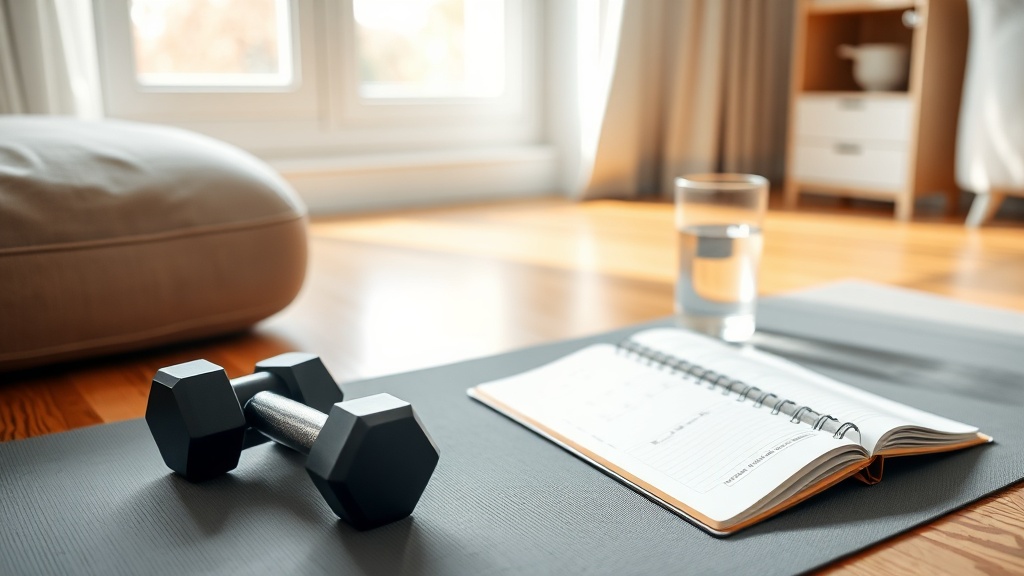
But I built my entire transformation alone, in my apartment, with a cheap set of dumbbells and a free YouTube channel. Not because I'm a loner—I'm a teacher, I spent my whole career in group settings—but because I didn't have the schedule flexibility for a 6:00 AM class, and I couldn't afford the gym membership at the time.
What I've found, both in my own experience and in watching people actually stick with fitness long-term, is this: structure outlasts motivation, and motivation is what community provides. If the structure is good—if the habit is built into your day and doesn't require decision-making or external accountability to execute—it runs without fuel.
Community can be great. It can also be a crutch that prevents you from building the internal system you actually need. And it can be a way for the fitness industry to sell you a premium studio membership when a $30 kettlebell and a plan would work better.
The question isn't "do I have enough community?" It's "do I have a system simple enough that I'll do it even when motivation is zero?"
Rebuilding From Scratch: What This Actually Looks Like
If you're a woman who's tried multiple programs and keeps hitting the same walls, here's what I'd suggest—not as a pep talk, as a structural reframe.
Step 1: Reset the volume expectation.
You do not need five days a week. Three is plenty. If you're currently doing zero, one is an astronomical improvement over zero.
Step 2: Make it compound and brief.
Full-body, three days, 30–40 minutes. Something like:
- Goblet squat or leg press (quad-dominant)
- Romanian deadlift or hip hinge (posterior chain)
- Push (dumbbell press or push-up)
- Pull (row, lat pulldown)
- One carry or core movement (farmer carry, plank)
Three sets of each, 8–12 reps, done. That's the program. Everything else is detail.
Step 3: Measure strength, not scale weight.
Can you squat more than you could last month? Can you row a heavier dumbbell? That's progress. The scale conflates water retention, muscle gain, and hormonal fluctuation into one useless number. Track what's actually changing.
Step 4: Note your cycle, loosely.
Not four-phase complexity. Just two windows. When you feel good, push. When you don't, maintain or reduce. Remove the guilt from the low-energy days. That's not failure. That's your body in luteal phase with elevated core temp—you're not supposed to PR.
Step 5: Protect the structure.
Put your three workouts in your calendar like a meeting you can't reschedule. Make them short enough that canceling them feels ridiculous. Put your gear out the night before. Remove the friction, and the habit runs itself.
International Women's Day is March 8. I think women deserve more than a week of empowerment content followed by programs that still don't account for their physiology or their schedules.
The more useful gift is a program designed for how women's bodies actually work, built around the time women actually have, and freed from the idea that you're failing when the program was the thing that failed.
The system matters more than the motivation. Build a better system.